This is the multi-page printable view of this section. Click here to print.
Blog
- Information on Parquet Features
- ALP: Adaptive Lossless Floating-Point Encoding in Apache Parquet
- Taming Floating-Point Statistics in Apache Parquet: IEEE 754 Total Order and NaN Counts
- Variant Type in Apache Parquet for Semi-Structured Data
- Native Geospatial Types in Apache Parquet
- Parquet Format Releases
- Parquet-Java Releases
Information on Parquet Features
ALP: Adaptive Lossless Floating-Point Encoding in Apache Parquet
Apache Parquet has added the Adaptive Lossless floating-Point (ALP) Encoding – a new lightweight floating-point encoding with compression ratios similar to zstd, much faster decompression, random-access support, and GPU- and SIMD-friendly decoding.
ALP works best for decimal values stored as floating-point types (32-bit FLOAT and 64-bit DOUBLE), such as
- Monetary values (exchange rates, public funds, stocks, prices, etc.) – e.g.,
1.2345or22.03 - Geographic coordinates (longitude/latitude) – e.g.,
42.3584,-71.0598 - Scientific measurements (temperature, pressure, speed, degrees, etc.) – e.g.,
-273.15,9.81,3.14159
ALP is not suitable for data that uses a wide range of exponents or a large
number of significant digits, such as vector embeddings, which typically span
the full floating-point range. Such data can continue to use existing Parquet
features such as PLAIN or BYTE_STREAM_SPLIT encoding followed by
general-purpose compression like ZSTD.
Decimal values can be stored with Parquet’s DECIMAL logical type, but that
type requires the precision and scale to be known and declared up front and
cannot store values outside that range. For this reason, systems commonly
store decimal values as FLOAT or DOUBLE when the exact shape of their data
is not known beforehand. For example,
JavaScript’s only* number type is DOUBLE, common data science tools such as
pandas infer float64 for decimal-looking values, and NumPy has no decimal dtype at all.
* JavaScript also has BigInt, but it can only represent integers.
Why ALP?
Encoding floating-point data is a complicated engineering problem due to the nature of floating-point values. They do not exactly represent most real numbers. This leads to rounding errors that prevent the use of existing lightweight encodings like Delta and Frame of Reference.
Prior to ALP, BYTE_STREAM_SPLIT was the only non-dictionary alternative to
PLAIN for FLOAT/DOUBLE values in Parquet. It does not reduce the size of the
data but can improve the compression ratio and speed when a heavyweight
compressor is used afterwards.
Heavyweight compression effectively decreases the data size, but at the cost of:
- Decode speed – decompression speed is often the bottleneck in data access.
- Random access – reading one value requires decoding an entire data page containing potentially thousands of other values.
- Data dependence – variable-length compression means that decoding a value requires decoding previous values, making it hard to parallelize with modern hardware such as SIMD instructions and GPUs.
ALP is designed to solve all three of these problems for common data patterns, while achieving a similar compression ratio to heavyweight compression.
Parquet applies an encoding first, then an optional compression codec as a
separate step. The charts below compare the PLAIN and BYTE_STREAM_SPLIT
encodings followed by ZSTD compression with the ALP encoding and no
additional compression. Users can expect ALP to decode 10x faster and
retrieve individual values thousands of times faster, with a slightly lower
compression ratio and slightly faster compression.1
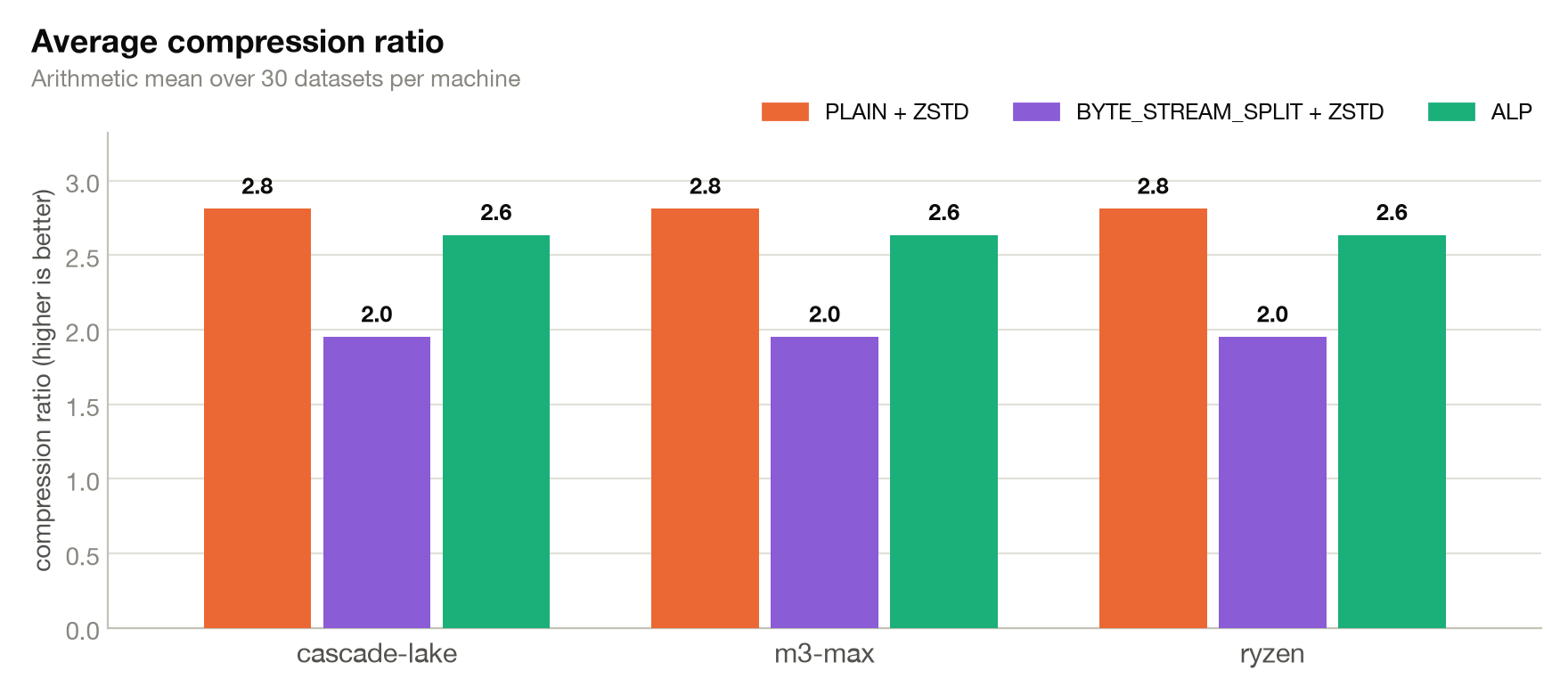
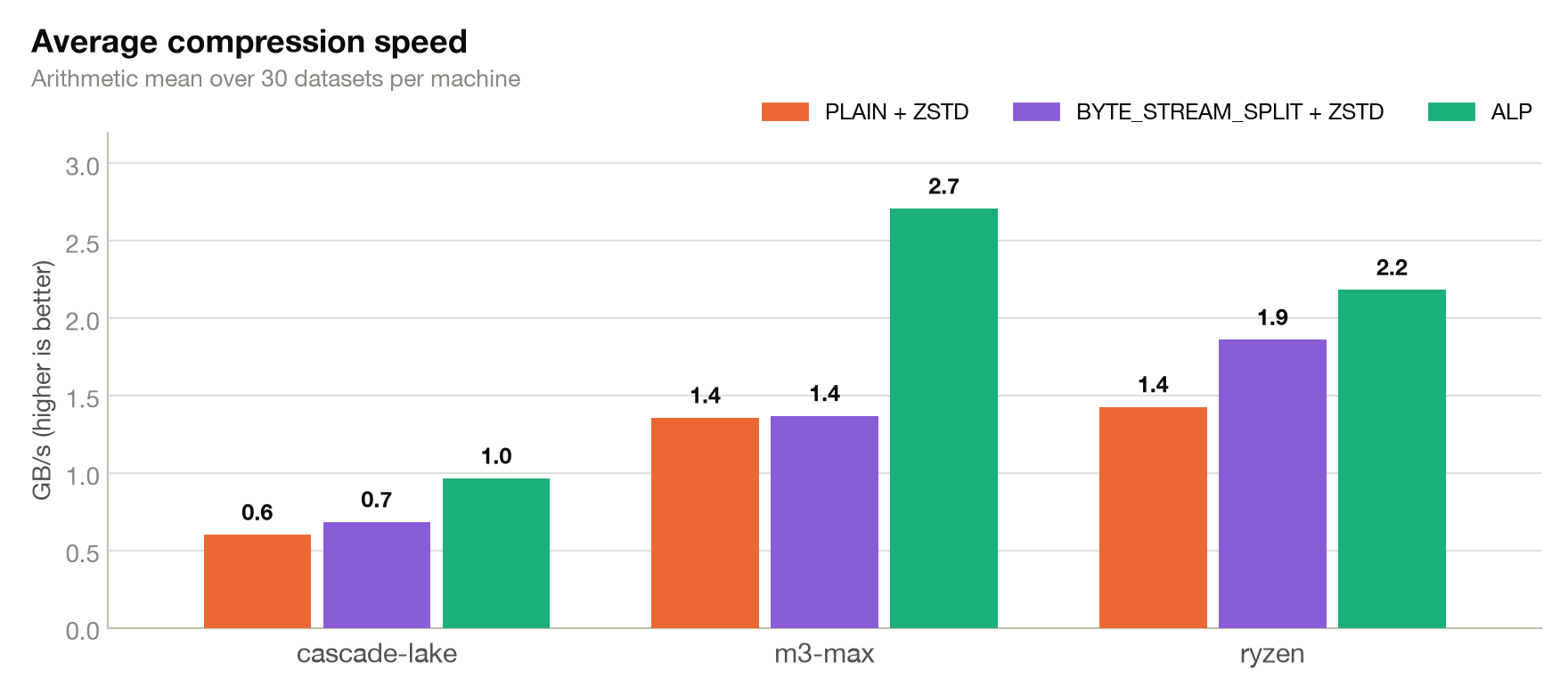
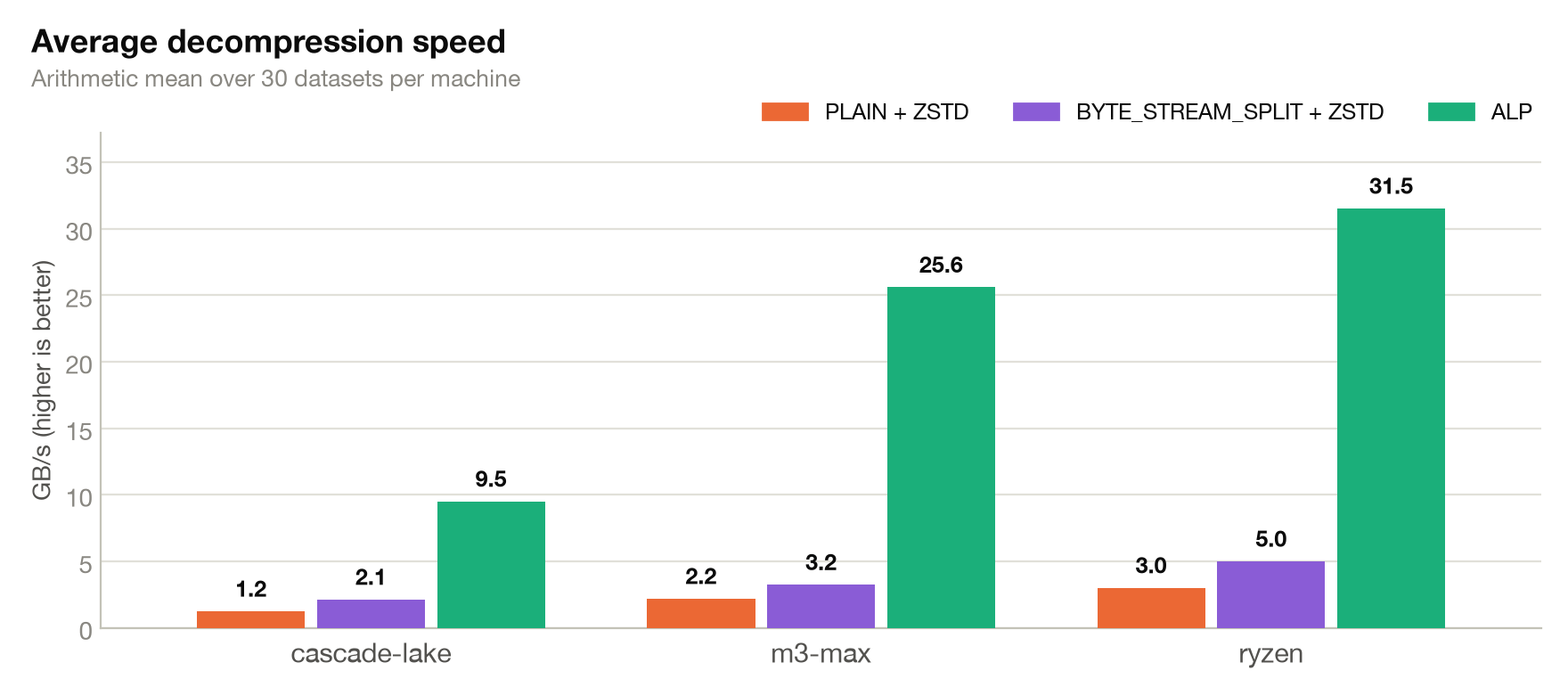
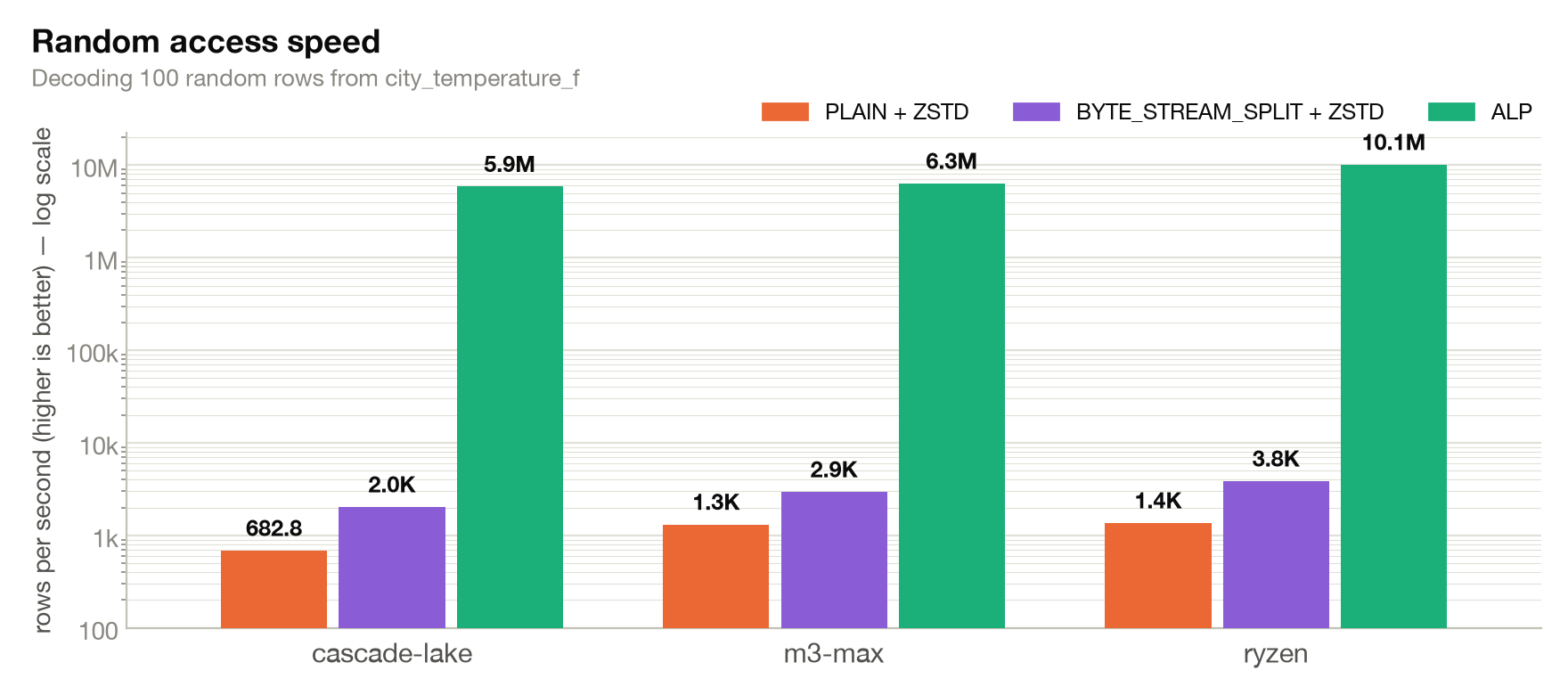
PLAIN+ZSTD and BYTE_STREAM_SPLIT+ZSTD (each encoding followed by per-page ZSTD compression), and ALP (no compression codec), across 30 datasets on 3 machines. Higher is better.
Random-access speed is measured by decoding 100 deterministic, uniformly distributed rows from city_temperature_f.Note that these numbers are for the pre-release Rust implementation of ALP, and
we expect performance to improve as implementations are optimized and tuned.
Even so, ALP is already faster than zstd in many cases, despite years of
optimization work on zstd implementations. We also measured similar
improvements for the C++ implementation.
Technical Overview
ALP takes advantage of a common pattern: many values stored as FLOAT or
DOUBLE originated as decimal numbers with relatively few digits, such as
prices or measurements. This section explains the intuition behind ALP and
then covers the encoding and decoding pipelines in more detail.
ALP encodes floating-point values in batches called “vectors”, ranging in size from 8 to 32K values (e.g., 1024). Each value in a vector is encoded as an
integer, and the vector stores two integer parameters shared by all its
values: an “exponent” (e) and a “factor” (f). Each vector can use a
different exponent and factor. How they are chosen is explained below. The
original value is recovered by computing
value = encoded × 10f × 10-e
This calculation uses floating-point arithmetic, which rounds to the nearest
representable value and thus may not reproduce the original value exactly. When
that happens, ALP stores the original full-precision value separately as an
“exception”, keeping the encoding lossless. Special values such as NaN,
±Infinity, and -0.0 are also stored as exceptions.
Within each vector, the encoded values are stored by subtracting the lowest value (the frame of reference) and then bit-packing to a fixed width. Exceptions are stored directly after the encoded array. The layout of each ALP vector is shown below.
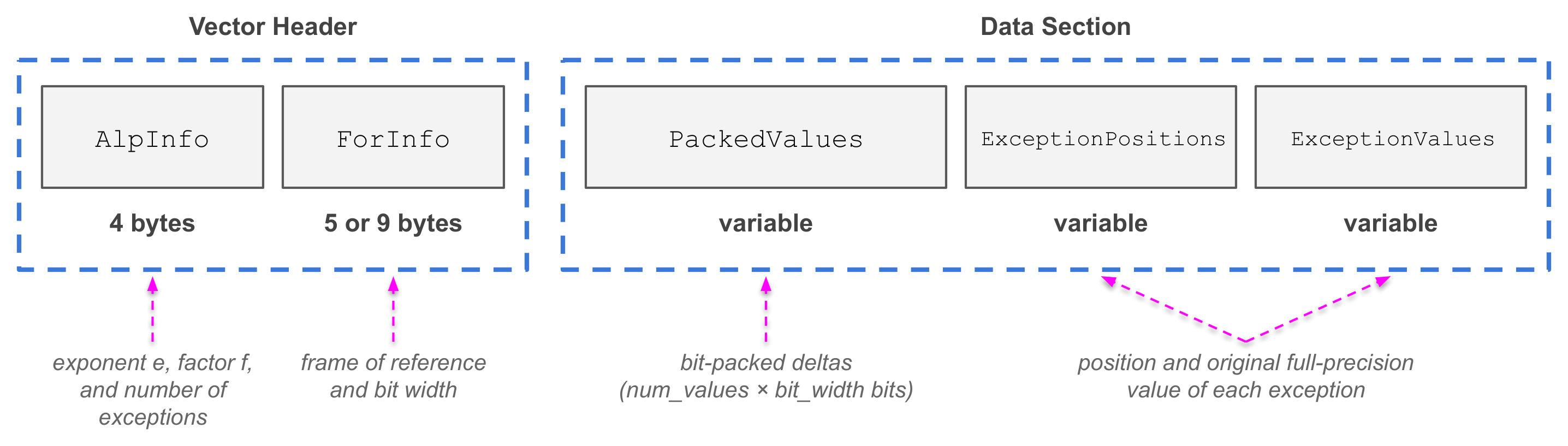
Since each value is stored as a bit-packed integer of a fixed width, locating an arbitrary row requires only computing the offset of its encoded bits. Applying the frame of reference, exponent, and factor to that integer recovers the original floating-point value. Finally, the exception indices are checked for the target row, and if an exception is present, its value is returned instead.
Example
Consider encoding the value 8.0605, which cannot be exactly
represented in IEEE 754. It is stored as
the 32-bit floating-point number 8.06050014495849609375. It can also be
encoded as 80605 with exponent e = 8 and factor f = 4. Applying
the recovery formula with 32-bit floating-point arithmetic, which rounds after
each multiplication, yields
80605 × 104 × 10-8 → 8.06050014495849609375 (FLOAT)
This is the nearest representable FLOAT to 8.0605 and matches the original
stored floating-point value exactly. However, if the original value had been
8.0605123 (stored as the 32-bit value 8.060512542724609375), the encoded
value would still be 80605 and the decoded value still
8.06050014495849609375, which differs from the original. That value would
therefore be stored as an exception.
Picking the exponent and factor well is key to ALP’s performance. Each Parquet writer is free to choose them for each vector using any algorithm. The Parquet specification provides an example sampling-based algorithm that aims to minimize the encoded size. Typically, the exponent is chosen to capture most decimal digits in the vector while minimizing exceptions, and the factor is chosen to remove as many trailing zeros as possible.
Example
Assuming some value in the vector requires e = 8, it is valid to encode
0.0123, 0.0245, and 0.0201 with multiple factor choices:
e = 8, f = 0:1230000,2450000,2010000e = 8, f = 4:123,245,201
The second choice is better: it yields smaller encoded values, which require fewer bits to store.
Finally, ALP subtracts the minimum encoded value (the frame of reference) from every encoded value before bit-packing, further reducing the bits required.
Example
The values above require only 7 bits each after subtracting the frame of reference:
- Input values:
123,245, and201(8bits per value) - Minimum value (frame of reference):
123 - Final bit-packed values:
0,122, and78(7bits per value)
The encoding pipeline is straightforward, as shown in the following example of encoding a vector:
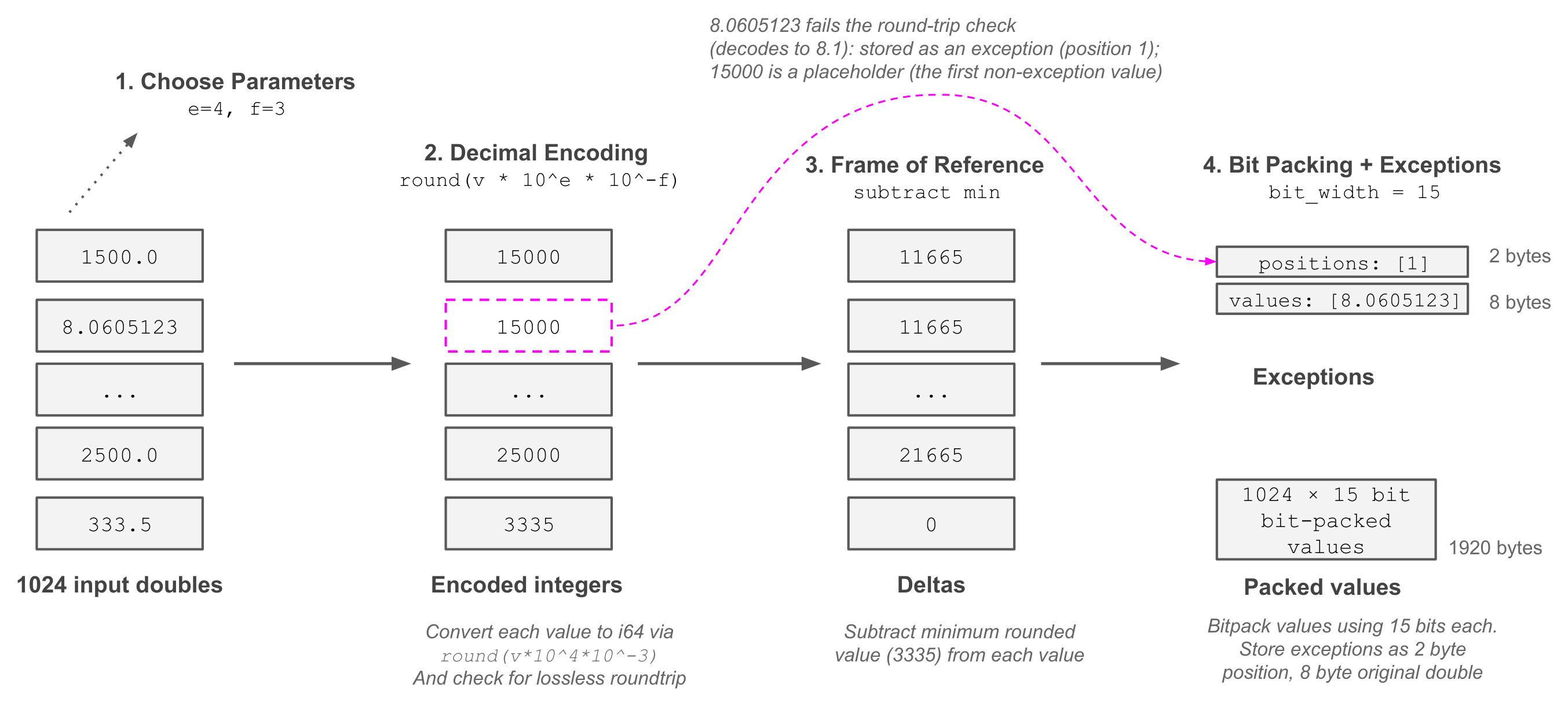
1024 64-bit floating-point values using ALP.To encode this vector, the parameters e = 4 and f =
3 are chosen first. Then the values are transformed to integers using the
formula encoded = round(value × 104 × 10-3). Each integer is
checked by reversing the transformation with decoded = encoded × 103 × 10-4.
Values that do not round-trip, such as 8.0605123 (which decodes to 8.1), are
stored in the exception array. The minimum value across the vector, 3335,
becomes the frame of reference and is subtracted from each integer, and the
resulting deltas are bit-packed using 15 bits.
In this example, ALP uses 1920 bytes for the bit-packed deltas, plus a
13-byte vector header and space for exceptions. PLAIN uses 8192 bytes for
the same 1024 values. This comparison excludes page-level metadata for both
encodings. See the ALP Encoding specification for more details on how the
parameters are chosen and how rounding and exception handling work.
Decoding a vector requires similar steps, but in reverse, as shown below.
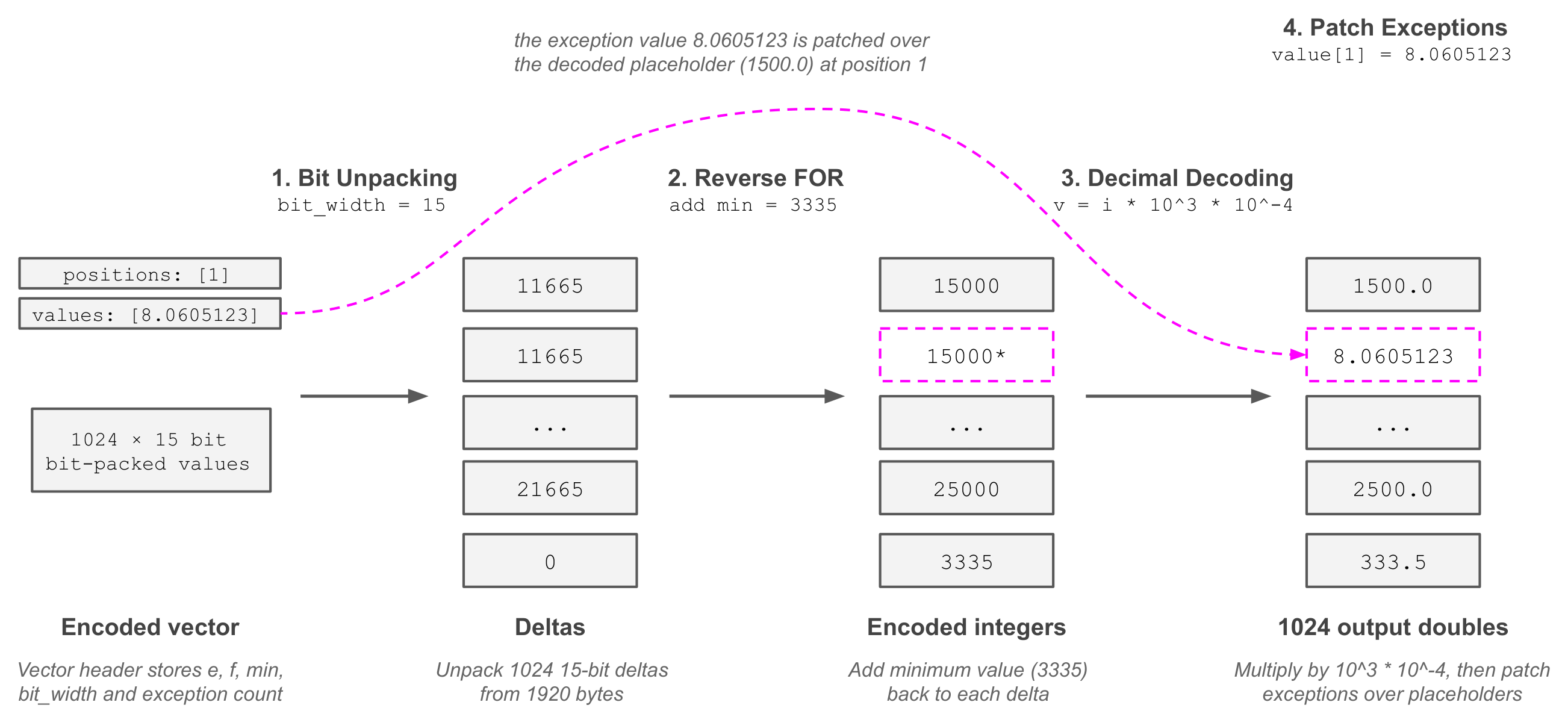
1024 values back to floating-point values using ALP.First, the bit-packed deltas are unpacked, and the original values are computed
by original = (3335 + delta) × 103 ×
10-4. Then any exceptions are “patched” by overwriting the
output array at the exception positions with the exception values.
Acknowledgements
ALP was first published in a SIGMOD 2024 paper by Azim Afroozeh, Leonardo Kuffó, and Peter Boncz from the Database Architectures Group at CWI. The Vortex and Lance formats adopted ALP early, demonstrating its benefits in industrial applications. In late 2025, the community began the standardization process. Along with the authors of this blog post, many community members contributed, including Divjot Arora, Arnav Balyan, Devan Benz, Ryan Blue, Alkis Evlogimenos, Xuwei Fu, Vinoo Ganesh, Adrian Garcia Badaracco, Curt Hagenlocher, Amogh Jahagirdar, Micah Kornfield, Robert Kruszewski, Julien Le Dem, Kevin Liu, Steve Loughran, Ismaël Mejía, Antoine Pitrou, Adam Reeve, Ed Seidl, Russell Spitzer, Matt Topol, Jeffrey Vo, Daniel Weeks, Gang Wu, and Zehua Zou.
Ecosystem Adoption
The encoding was released as part of parquet-format 2.14.0 in September 2026.
ALP is already supported in at least one major open-source implementation (the
parquet 60.0.0 Rust crate), and we expect other Parquet
implementations to add support in the coming months. Please check the
Implementation Status page for the current state of support.
You can also try it today on your own datasets using the tool in the ALP benchmark repository.
Conclusion
ALP brings fast, parallelizable decoding and practical random access to floating-point data in a standard form that any Parquet implementation can read once it adds support for the encoding. Its addition is one more example of Apache Parquet evolving to meet the needs of modern data systems.
As with all additions to Parquet, this was a community endeavor, with many individuals and vendors working together to agree on a common standard and produce a well-documented specification and multiple reference implementations. We expect ALP to be widely adopted in the Parquet ecosystem over the coming years.
Resources
The code and instructions to reproduce these results and try ALP on your own Parquet datasets are in the alp_benchmark repository, which uses the Rust Parquet implementation. ↩︎
Taming Floating-Point Statistics in Apache Parquet: IEEE 754 Total Order and NaN Counts
Column statistics are the secret to Apache Parquet’s blazing fast performance. By storing compact summaries—like min, max, and null counts—for row groups, column chunks, and pages, readers can easily skip irrelevant data that doesn’t match a query.
However, floating-point values throw a wrench into this simple model. The IEEE 754 standard defines special values like NaN (Not a Number), signed zeros (-0.0 and +0.0), and infinities. Their comparison rules don’t play well with the simple “total order” (a strict smaller-to-larger ranking) expected by most data-pruning algorithms. To fix this, the Parquet community recently clarified the standard by combining IEEE 754 total order semantics with an explicit nan_count field in the statistics.
The result is a much clearer contract between data writers and readers. Floating-point bounds can now be interpreted consistently, and readers can confidently determine if NaN values are present, without having to guess based solely on min and max bounds.
Why Floating-Point Statistics Need Special Handling
For integers, strings, and many other straightforward types, Parquet statistics are simple: the writer records the absolute smallest and largest values, and the reader uses those bounds to decide if a query might find a match.
Floating-point columns are trickier for two major reasons. First, -0.0 and +0.0 are considered equal in normal math operations, yet they possess distinct underlying bit patterns. A data format needs strict rules on how to order these values; otherwise, different libraries might generate conflicting statistics for the exact same underlying data. Parquet’s approach to dealing with this ambiguity has been to mandate that a min of 0.0 always be written as -0.0, and a max of 0.0 always be written as +0.0, regardless of any sign bits that may be present in the actual data. Readers are advised that -0.0 may be present even if the min is +0.0, and +0.0 may be present even if the max is -0.0.
Second, NaN is completely unordered under standard IEEE 754 comparisons. Expressions like x < NaN, x > NaN, and x == NaN always evaluate to false. If a writer blindly includes NaN in ordinary min or max calculations, the resulting bounds might be useless for skipping data. To date Parquet has followed the latter approach, forbidding the inclusion of NaN in the statistics. PR #196 provides a detailed overview of the problems inherent in this approach. For instance, consider a page with a max statistic of 0.0 that also contains a NaN. A query engine that considers NaN to be greater than all values attempts a query with a predicate like x > 1.0. If the engine examines the statistics, it will see that the max is 0.0, so it might improperly skip that page, even though it contains at least one row that satisfies the predicate. Without knowledge of the presence or absence of NaN, the engine cannot safely perform this type of page pruning for floating point columns.
These aren’t just theoretical edge cases. Query engines rely heavily on these statistics to safely skip large chunks of data. Ambiguous floating-point bounds degrade query performance and can lead to severe inconsistencies. PARQUET-2249 exposed another critical flaw in how NaN values interacted with Parquet’s ColumnIndex metadata.
The core problem in PARQUET-2249 arose when a data page contained only NaN values. Such a page isn’t considered “null”—the data is physically there, and NaN is distinct from a missing null value. However, older guidelines stated that NaN values shouldn’t be included when computing min and max. This put the ColumnIndex in an impossible situation: it strictly required valid min and max bounds for any non-null page, yet there were no non-NaN values available to use!
How the Community Reached Consensus
The final solution didn’t emerge overnight. The discussion began with PR #196 in March 2023, which proposed adding a nan_count to floating-point statistics. This neatly solved one problem: making it explicitly clear whether a chunk of data contains NaNs. It also provided a safe migration path, as the new field could be added without breaking older readers.
However, adding nan_count alone didn’t completely solve the ColumnIndex dilemma. For page and column chunk statistics, a reader can combine num_values, null_count, and nan_count to deduce if all non-null values are NaN. But ColumnIndex doesn’t store num_values, making that math impossible. The community brainstormed various workarounds, like writing NaN directly into the bounds or adding special markers (like nan_pages). Each idea solved part of the puzzle but introduced new complexities or metadata bloat.
PR #221 explored an alternative route: introducing a brand new IEEE_754_TOTAL_ORDER for floating-point columns. This gave physical FLOAT, DOUBLE, and logical FLOAT16 values a strict, deterministic position, sorting out the signed zeros and different NaN bit patterns. However, this approach had a critical flaw on its own: because NaN values are placed at the absolute extremes of the total order, the presence of even a single NaN would pollute the min or max bounds, rendering normal numeric predicate pushdown completely ineffective. Furthermore, while it elegantly removed ordering ambiguity, it required an opt-in from readers and writers, and didn’t fully answer how much readers should know about the presence of NaNs in older files.
Ultimately, the community reached a consensus: why not combine the best of both worlds? PR #514, opened in August 2025 and merged in May 2026, successfully merged IEEE_754_TOTAL_ORDER with NaN counts. The new order strictly defines how bounds are compared, while nan_count clearly flags the presence of NaNs. Because no legacy writer uses the new order, the spec now safely requires nan_count whenever IEEE_754_TOTAL_ORDER is used, while gracefully handling older files.
The Solution
The resulting specification elegantly marries two concepts: an optional nan_count field for both Statistics and ColumnIndex, and the IEEE_754_TOTAL_ORDER column order.
nan_count records the exact number of NaN values within a given scope. Because the field is optional (or completely missing from older files), readers must treat a missing nan_count differently than a 0. If missing, readers must cautiously assume NaN values might be present. If a column is written using IEEE_754_TOTAL_ORDER, the writer is forced to provide the nan_count.
This new total order applies exclusively to physical FLOAT, DOUBLE, or logical FLOAT16 columns. It defines a strict, deterministic ordering for bit patterns with these key properties:
-0.0is ordered strictly before+0.0.- Negative
NaNvalues are ordered below all other values. - Positive
NaNvalues are ordered above all other values. - Different
NaNbit patterns have their own deterministic internal order.
For columns utilizing IEEE_754_TOTAL_ORDER, min_value and max_value must represent the smallest and largest non-NaN values. However, if all non-null values are NaN (solving the PARQUET-2249 issue), then min_value and max_value fall back to the smallest and largest NaN values as defined by the total order. Readers then check nan_count to know what they’re dealing with.
Together, these rules empower readers to interpret floating-point statistics confidently, free from the quirks of different implementation languages.
Implementation Guidance
Data writers producing floating-point statistics must now be explicit. If writing FLOAT, DOUBLE, or FLOAT16 using IEEE_754_TOTAL_ORDER, writers must compute bounds using this exact total order and include the nan_count.
Interestingly, implementing this ordering doesn’t require a heavy, complex comparison engine. A simplified logic sketch (written in Rust, but easily adaptable to C++, Java, Python, or Go) looks like this:
pub fn totalOrder(x: f64, y: f64) -> bool {
    let mut x_int = x.to_bits() as i64;
    let mut y_int = y.to_bits() as i64;
    // arithmetic shift
    x_int ^= (((x_int >> 63) as u64) >> 1) as i64;
    y_int ^= (((y_int >> 63) as u64) >> 1) as i64;
    return x_int <= y_int;
}
The same clever trick applies to 32-bit floats (f32): preserve the IEEE bit pattern, flip negative values so their integer representations sort correctly, and compare the resulting integers. The key takeaway for developers is that min_value and max_value must be computed with the identical total-order semantics advertised in the file’s ColumnOrder.
Readers, conversely, should treat a missing nan_count with caution. Absence doesn’t mean zero; it means “unknown,” so NaN values may lurk inside. When nan_count is present, readers can pair it with min and max bounds to make hyper-efficient, safe pruning decisions.
Implementations that haven’t adopted the new rules yet should continue handling older files conservatively, particularly when queries involve NaN or signed zeros, but also in the case of inequalities not involving NaN.
Conclusion
By embracing IEEE 754 total order and nan_count, Apache Parquet now boasts a much clearer, robust foundation for floating-point statistics. This update preserves the blazing speed of predicate pushdown while finally taming the edge cases: NaN values are accurately counted, signed zeros have their rightful place, and all floating-point bit patterns can be ordered deterministically.
It’s a small but mighty refinement to the Parquet format. It boosts interoperability across different programming languages and query engines, giving readers the precise information they need to prune data with confidence.
Resources
Variant Type in Apache Parquet for Semi-Structured Data
The Apache Parquet community is excited to announce the addition of the Variant type—a feature that brings native support for semi-structured data to Parquet, significantly improving efficiency compared to less efficient formats such as JSON. This marks a significant addition to Parquet, demonstrating how the format continues to evolve to meet modern data engineering needs.
While Apache Parquet has long been the standard for structured data where each value has a fixed and known type, handling heterogeneous, nested data often required a compromise: either store it as a costly-to-parse JSON string or flatten it into a rigid schema. The introduction of the Variant logical type provides a native, high-performance solution for semi-structured data that is already seeing rapid uptake across the ecosystem.
What is Variant?
Variant is a self-describing data type designed to efficiently store and process semi-structured data—JSON-like documents with arbitrary and evolving schemas.
Why Variant?
Consider a common scenario: storing logged event data that might evolve as new events are added, or fields are added or removed from specific event types. For example, you might have events like:
{"timestamp": "2026-01-15T10:30:00Z", "user": 5, "event": "login"}
{"timestamp": "2026-01-15T11:45:00Z", "user": 5, "event": "purchase", "amount": 99.99}
{"timestamp": "2026-01-15T12:00:00Z", "user": 7, "event": "login", "device": "mobile"}
Traditional approaches that store JSON as text strings require full parsing to access any field, making queries slow and resource-intensive. Variant solves this by storing data in a structured binary format that enables direct field access through offset-based navigation. Query engines can jump directly to nested fields without deserializing the entire document, dramatically improving performance.
Binary encodings like BSON improve upon plain JSON by storing data in binary format, but they still redundantly store field names like "timestamp", "user", and "event" in every row, wasting storage space. Variant is optimized for the common case where multiple values share a similar structure: it avoids redundantly storing repeated field names and standardizes the best practice of “shredded storage” for pre-extracting structured subsets.
Key Benefits
Type-Preserving Storage: Original data types are maintained in their native formats—data types (integers, strings, booleans, timestamps, etc.) are preserved, unlike JSON which has a limited type system with no native support for types like timestamps or integers.
Efficient Encoding: The binary format uses field name deduplication to minimize storage overhead compared to JSON strings or BSON encoding.
Fast Query Performance: Direct offset-based field access provides performance improvements over JSON string parsing. Optional shredding of frequently accessed fields into typed columns further enhances query pruning and predicate pushdown.
Schema Flexibility: No predefined schema is required, allowing documents with different structures to coexist in the same column. This enables seamless schema evolution while maintaining full queryability across all schema variations, while still taking advantage of common structures when present.
Overview of Variant Type in Parquet
Parquet introduced the Variant logical type in August 2025.
Variant Encoding
In Parquet, Variant is represented as a logical type and stored physically as a struct with two binary fields. The encoding is designed so engines can efficiently navigate nested structures and extract only the fields they need, rather than parsing the entire binary blob.
optional group event_data (VARIANT(1)) {
  required binary metadata;
  required binary value;
}
metadata: Encodes type information and shared dictionaries (for example, field-name dictionaries for objects). This avoids repeatedly storing the same strings and enables efficient navigation.value: Encodes the actual data in a compact binary form, supporting primitive values as well as arrays and objects.
Example
A web access event can be stored in a single Variant column while preserving the original data types:
{
  "userId": 12345,
  "events": [
    {"eType": "login", "timestamp": "2026-01-15T10:30:00Z"},
    {"eType": "purchase", "timestamp": "2026-01-15T11:45:00Z", "amount": 99.99}
  ]
}
Compared with storing the same payload as a JSON string, Variant retains type information (for example, timestamp values are stored as integers rather than being stored as strings), which improves correctness, enables more efficient querying and requires fewer bytes to store.
Just as importantly, Variant supports schema variability: records with different shapes can coexist in the same column without requiring schema migrations. For example, the following record can be stored alongside the event record above:
{
  "userId": 12345,
  "error": "auth_failure"
}
Shredding Encoding
To enhance query performance and storage efficiency, Variant data can be shredded by extracting frequently accessed fields into separate, strongly-typed columns, as described in the detailed shredding specification. For each shredded field:
- If the field matches the expected schema, its value is written to the strongly typed field.
- If the field does not match, the original representation is written as a Variant-encoded binary field and the corresponding strongly typed field is left NULL.
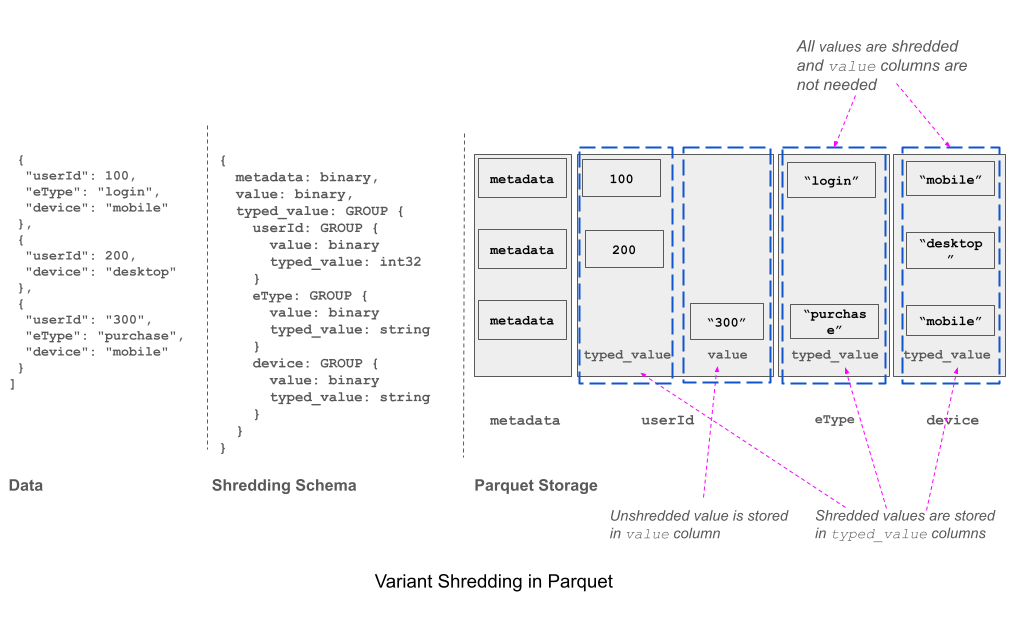
The Parquet writer, typically a query engine, decides which fields to shred based on access patterns and workload characteristics. Once shredded, the standard Parquet columnar optimizations (encoding, compression, statistics) are used for the typed columns.
Implementation Considerations
Schema Inference: Engines can infer the shredding schema from sample data by selecting the most frequently occurring type for each field. For example, if
event.idis predominantly an integer, the engine shreds it to an INT64 column.Type Promotion: To maximize shredding coverage, engines can promote types within the same type family. For example, if integer values vary in size (INT8, INT32, INT64), selecting INT64 as the shredded type ensures all integer values can be shredded rather than falling back to the unshredded representation.
Metadata Control: To control metadata overhead, engines may limit the number of shredded fields, since each field contributes statistics (min/max values, null counts) to the file footer and column stats.
Explicit Shredding Schema: When read patterns are known in advance, engines can specify an explicit shredding schema at write time, ensuring that frequently accessed fields are shredded for optimal query performance.
Performance Characteristics
Selective field access: When queries access only the shredded fields, only those columns are read from Parquet, skipping the rest, benefiting from column pruning and predicate pushdown.
Full Variant reconstruction: When queries require access to the complete Variant object, there is a performance overhead as the engine must reconstruct the Variant by merging data from the shredded typed fields and the base Variant column.
Examples of Shredded Parquet Schemas
The following example shows shredding non-nested Variant values. In this case, the writer chose to shred string values as the typed_value column. Rows that do not contain strings are stored in the value column with binary Variant encoding.
optional group SIMPLE_DATA (VARIANT(1)) = 1 {
    required binary metadata;             # variant metadata
    optional binary value;                # non-shredded value
    optional binary typed_value (STRING); # the shredded value
}
The series of variant values "Jim", 100, {"name": "Jim"} are encoded as:
| Variant Value | value | typed_value |
|---|---|---|
"Jim" | null | "Jim" |
100 | 100 | null |
{"name": "Jim"} | {"name": "Jim"} | null |
Shredding nested Variant values is similar, with shredding applied recursively, as shown in the following example. In this case, the userId field is shredded as an integer and stored in two columns: typed_value.userId.typed_value when the value is an integer, and typed_value.userId.value otherwise. Similarly, the eType field is shredded as a string and stored in typed_value.eType.typed_value and typed_value.eType.value.
optional group EVENT_DATA (VARIANT(1)) = 1 {
    required binary metadata;                 # variant metadata
    optional binary value;                    # non-shredded value
    optional group typed_value {
      required group userId {                 # userId field
        optional binary value;                # non-shredded value
        optional int32 typed_value;           # the shredded value
      }
      required group eType {                  # eType field
        optional binary value;                # non-shredded value
        optional binary typed_value (STRING); # the shredded value
      }
    }
}
The table below illustrates how the data is stored:
| Variant Value | value | typed_value.userId.value | typed_value.userId.typed_value | typed_value.eType.value | typed_value.eType.typed_value |
|---|---|---|---|---|---|
{"userId": 100, "eType": "login"} | null | null | 100 | null | "login" |
100 | 100 | null | null | null | null |
{"userId": "Jim"} | null | "Jim" | null | null | null |
{"userId": 200, "amount": 99} | {"amount": 99} | null | 200 | null | null |
Ecosystem Adoption: A Success Story
One of the most remarkable aspects of Variant’s addition to Parquet is the rapid and widespread ecosystem adoption, demonstrating the strength of collaboration within the Apache Parquet community.
Variant support has been implemented across multiple Parquet libraries including Java, Rust, and Go. For the most current implementation status across all languages and platforms, refer to the official Parquet implementation status page.
Major query engines have also integrated Variant support, including DuckDB, Apache Spark, and Snowflake. This cross-ecosystem adoption highlights both the value of the Variant type and the Parquet community’s commitment to evolving the format to meet modern data challenges.
Real-World Examples
This section illustrates how users can interact with Variant using Apache Spark 4.0
Event Stream Analytics
Event streaming applications often handle events with evolving schemas, where different event types contain varying fields. Variant provides a flexible solution for storing heterogeneous event data without requiring schema migrations.
Example: User Activity Events
-- Create table with Variant column
CREATE TABLE event_stream (
    event_id INTEGER,
    event_data VARIANT
);

-- Insert events with different schemas
INSERT INTO event_stream VALUES
    (1, PARSE_JSON('{"user": {"id": 100, "country": "US"}, "actions": ["login", "view_dashboard"]}')),
    (2, PARSE_JSON('{"user": {"id": 101, "country": "UK", "premium": true}, "actions": ["login", "upgrade"]}')),
    (3, PARSE_JSON('{"user": {"id": 102, "country": "CA"}, "session_duration": 3600}'));

-- Query events with path notation - handles different schemas gracefully
SELECT
    event_id,
    event_data:user.id::INTEGER as user_id,
    event_data:user.country::STRING as country,
    event_data:user.premium::BOOLEAN as is_premium
FROM event_stream;
IoT Sensor Data
IoT deployments often involve diverse sensor types, each producing data with unique structures. Traditional approaches require either separate tables per sensor type or complex union schemas, or inefficient JSON / BSON encoding. Variant enables unified storage while maintaining type safety.
Example: Multi-Sensor Data Pipeline
-- Create unified sensor table
CREATE TABLE sensor_readings (
    reading_id INTEGER,
    timestamp TIMESTAMP,
    sensor_data VARIANT
);

-- Insert data from different sensor types
INSERT INTO sensor_readings VALUES
    (1, '2026-01-28 10:00:00'::timestamp,
     PARSE_JSON('{"sensor_id": "T001", "temp": 72.5, "unit": "F", "battery": 95}')),
    (2, '2026-01-28 10:00:05'::timestamp,
     PARSE_JSON('{"sensor_id": "M001", "motion_detected": true, "confidence": 0.95, "zone": "entrance"}')),
    (3, '2026-01-28 10:00:10'::timestamp,
     PARSE_JSON('{"sensor_id": "C001", "image_url": "s3://bucket/img_001.jpg", "objects_detected": ["person", "vehicle"]}'));

-- Query temperature sensors only
SELECT
    reading_id,
    sensor_data:sensor_id::STRING as sensor_id,
    sensor_data:temp::FLOAT as temperature,
    sensor_data:unit::STRING as unit,
    sensor_data:battery::INTEGER as battery_level
FROM sensor_readings
WHERE sensor_data:sensor_id LIKE 'T%';
Conclusion
The addition of Variant to Apache Parquet represents a significant milestone in the format’s evolution. By standardizing Variant as a logical type within Apache Parquet, the format now provides efficient storage for semi-structured data, enables meaningful statistics collection, and ensures cross-engine interoperability.
The well-documented specification has catalyzed broad ecosystem adoption, with multiple reference implementations now available across languages. This cross-language support ensures that Variant can be seamlessly integrated into diverse data processing environments, from analytical databases to streaming platforms, making it a universal solution for handling evolving schemas in modern data architectures.
Resources
- Apache Parquet Format Specification: https://github.com/apache/parquet-format
- Variant Type Specification: Variant Logical Type
- Variant Encoding Specification: Variant Binary Encoding
- Variant Shredding Specification: Variant Shredding
- Community Discussions: dev@parquet.apache.org
Native Geospatial Types in Apache Parquet
Geospatial data has become a core input for modern analytics across logistics, climate science, urban planning, mobility, and location intelligence. Yet for a long time, spatial data lived outside the mainstream analytics ecosystem. In primarily non-spatial data engineering workflows, spatial data was common but required workarounds to handle efficiently at scale. Formats such as Shapefile, GeoJSON, or proprietary spatial databases worked well for visualization and GIS workflows, but they did not integrate cleanly with large scale analytical engines.
The introduction of native geospatial types in Apache Parquet marks a major shift. Geometry and geography are no longer opaque blobs stored alongside tabular data. They are now first class citizens in the columnar storage layer that underpins modern data lakes and lakehouses.
This post explains why native geospatial support in Parquet matters and gives a technical overview of how these types are represented and stored.
Why Geospatial Types Matter in Analytical Storage
Spatial data storage presents unique challenges: a single geometry may represent a point, a road segment, or a complex polygon with thousands of vertices. Queries are also different: instead of simple equality or range filters, users ask spatial questions such as containment, intersection, distance, and proximity in two (XY) or even three (XYZ) dimensions.
Historically, geospatial columns in Parquet were stored as generic binary or string values, with spatial meaning encoded in external metadata. This approach had several limitations.
- Query engines could not detect a column was GEOMETRY or GEOGRAPHY without an explicit function call by the user (even if the engine supported GEOMETRY or GEOGRAPHY types natively)
- Query engines could not apply statistics-based pruning: full Parquet files were required to be read even for spatial queries that returned a small number of rows.
Native geospatial types address these issues directly. By making geometry and geography part of the Parquet logical type system, spatial columns become visible to query planners, execution engines, and storage optimizers.
A key benefit is the ability to attach spatial statistics such as bounding boxes to column chunks and row groups. With bounding boxes available in Parquet statistics, engines can skip entire row groups that fall completely outside a query window. This dramatically reduces IO for spatial filters and joins, especially on large datasets.
In practice, this means that spatial analytics can finally benefit from the same performance techniques that made Parquet dominant for non-spatial workloads.
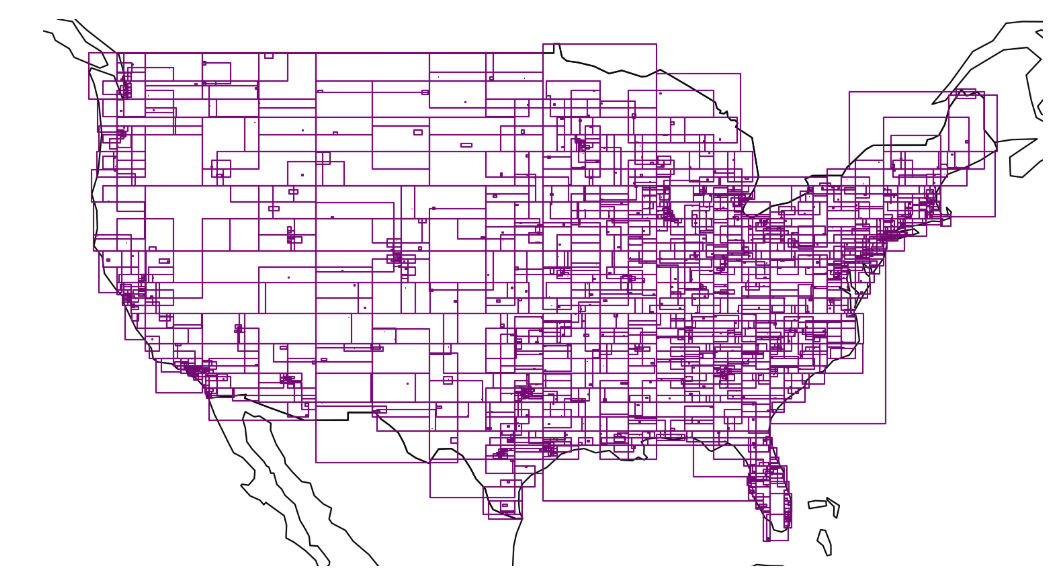
Figure 1: Visualization of bounding boxes for 130 million buildings stored in a Parquet file from the contiguous U.S. (Microsoft Buildings, file from geoarrow.org/data, visualization code here)
Consider a SedonaDB Spatial SQL query that filters buildings by intersection with a small region around Austin, Texas:
SELECT * FROM buildings
WHERE ST_Intersects(
    geometry,
    ST_SetSRID(
        ST_GeomFromText('POLYGON((-97.8 30.2, -97.8 30.3, -97.7 30.3, -97.7 30.2, -97.8 30.2))'),
        4326
    )
)
With bounding box statistics attached to each row group, the query engine compares the query window against each row group’s bounding box before reading any geometry data. In the visualization below, the query window (red box) overlaps with only 3 row groups out of 2,585 (highlighted in orange). The engine skips all other row groups entirely.
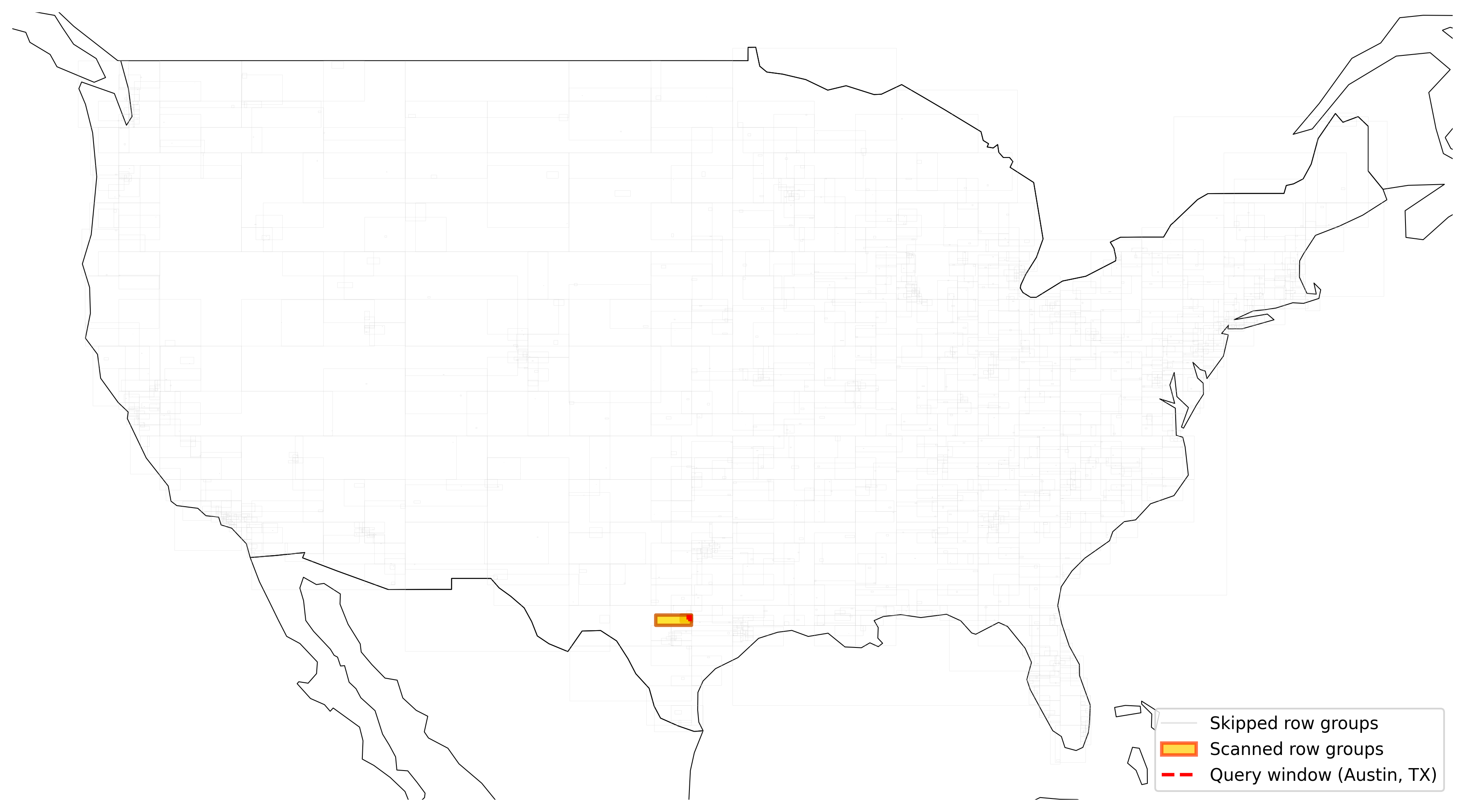
Figure 2: Spatial pruning in action: the query window over Austin (red) intersects only 3 row group bounding boxes (orange). The remaining 2,582 row groups (gray) are skipped without reading their data. (visualization code here)
From GeoParquet Metadata to Native Types
Before Parquet adopted GEOMETRY and GEOGRAPHY types in 2025, the GeoParquet community had already standardized how geometries should be stored in Parquet as early as 2022, using well known binary encoding plus a set of metadata keys. This was an important step because it enabled interoperability across tools.
However, geometry columns were still fundamentally binary columns with sidecar metadata. Engines had to explicitly opt in to understanding that metadata and its placement in the file key/value metadata made it difficult to integrate with primarily non-spatial engines that were not designed to be extended in this way. Moreover, data lake table formats such as Apache Iceberg require concrete, first class Parquet data types to enable engine interoperability, which sidecar metadata cannot adequately support.
The newer direction, sometimes referred to as GeoParquet 2.0, moves geospatial concepts directly into the Parquet type system. Geometry and geography are defined as logical types, similar in spirit to decimal or timestamp types. This eliminates ambiguity such that non-spatial engines are better able to integrate Geometry and Geography concepts, improving type fidelity and performance for spatial and non-spatial users alike.
Overview of Geospatial Types in Parquet
Parquet introduces two primary logical types for spatial data.
GEOMETRY
The GEOMETRY type represents planar spatial objects. This includes points, linestrings, polygons, and multi geometries. The logical type indicates that the column contains spatial objects, while the physical storage uses a standard binary encoding.
Typical examples include:
- Engineering or CAD data in local coordinates
- Projected map data such as Web Mercator or UTM
- Spatial joins and overlays where longitude and latitude data distributed over a small area or where vertices are closely spaced, such as intersections, unions, clipping, and containment analysis
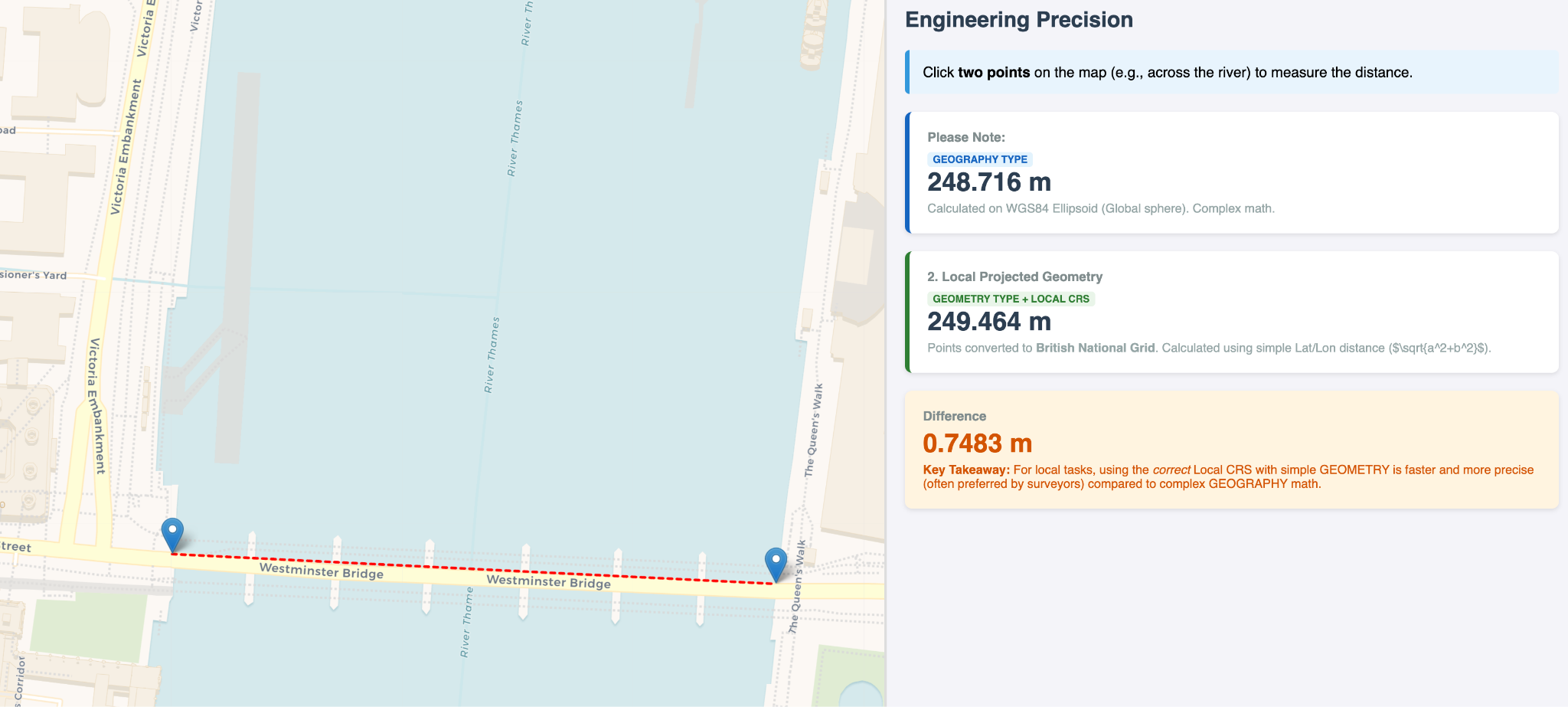
Figure 3: Building the London Westminster Bridge: the Geometry type under a local coordinate reference system would provide better precision and performance than the Geography type.
GEOGRAPHY
The GEOGRAPHY type is similar to GEOMETRY but represents objects on a spherical or ellipsoidal Earth model. Geography values are encoded using longitude and latitude coordinates expressed in degrees.
Common use cases include:
- Global scale datasets that span large geographic extents (e.g., country boundaries)
- Distance calculations where curvature of the earth matters (e.g., the distance between New York and Beijing)
- Use cases such as aviation, maritime tracking, or global mobility
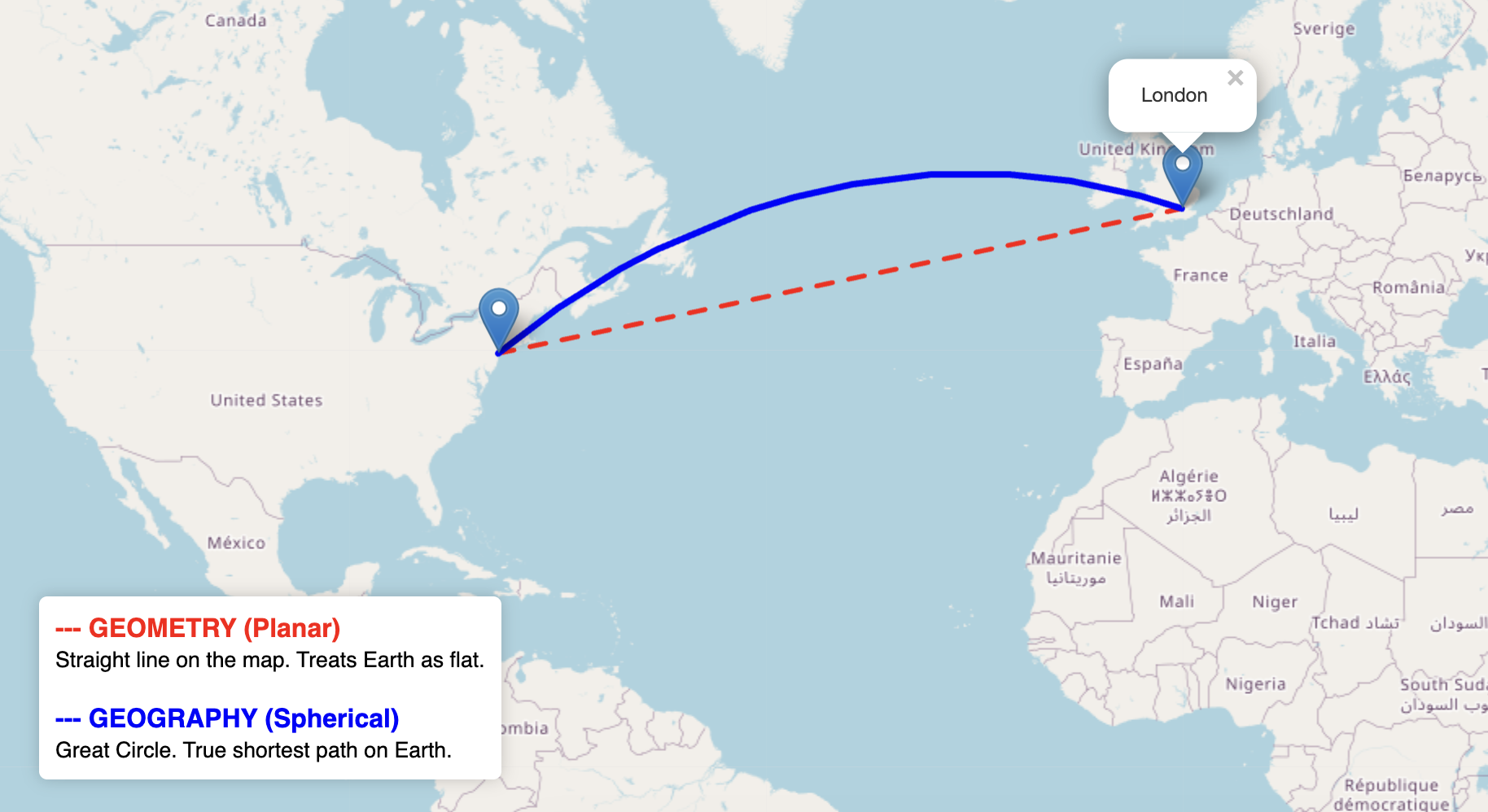
Figure 4: The shortest distance between London and NYC should cross Canada when using the Geography type, whereas the Geometry type incorrectly misses Canada.
Both types integrate into Parquet schemas just like other logical types. From the perspective of a schema definition, a geometry column is no longer an opaque binary field but a typed spatial column.
How Geospatial Types Are Stored
Although geospatial types are logical constructs, their physical storage follows Parquet’s existing columnar design. The following points highlight key aspects of the geospatial type design.
- Physical encoding Geometry and geography values are stored as binary payloads, using Well Known Binary (WKB) encoding. This ensures compatibility across engines and languages.
- Spatial statistics In addition to standard Parquet statistics such as null counts, spatial columns can carry bounding box information. Each row group can record the minimum and maximum extents of the geometries it contains. Query engines can use this information to prune data early when evaluating spatial predicates.
- Engine interoperability Because the spatial meaning is encoded as a Parquet logical type, engines do not need out of band conventions to interpret the column. A reader that understands Parquet geospatial types can immediately treat the column as a spatial object.
- Coordinate Reference System (CRS) information CRS information is stored in the file metadata (i.e., type definition) using authoritative identifiers or structured definitions such as EPSG codes or PROJJSON strings.
Native geospatial types align naturally with modern lakehouse architectures built on Parquet. Table formats such as Apache Iceberg no longer need to reinvent geospatial logic since core spatial semantics live in Parquet. Instead, they can focus on well defined type mappings between Parquet and Iceberg and on propagating spatial statistics into the tables.
Implementation status and ecosystem adoption
Native Parquet geo types are not theoretical. Geometry and geography have already been implemented across multiple core libraries, indicating broad and growing adoption.
Today, support exists in multiple languages and runtimes, including Parquet Java, Arrow C++, Rust, Hyparquet Javascript, DuckDB, and more! This ensures that geospatial Parquet files can be produced and consumed consistently across ecosystems, from JVM engines to native and embedded query engines.
An up to date view of implementation coverage can be found in the official Parquet documentation.
Conclusion
Native geospatial support in Apache Parquet represents a foundational improvement for spatial analytics and a welcome quality of life improvement for general-purpose workloads with a spatial component. By elevating geometry and geography to first class logical types, Parquet enables efficient storage, meaningful statistics, and true engine interoperability.
Bounding boxes, columnar layout, and standard encodings together allow spatial data to participate fully in modern analytics systems. As a result, geospatial workloads no longer need specialized storage formats or isolated systems. They can live natively inside the open, scalable data lake ecosystem.
To get started with Geometry/Geography in Parquet, see the example files provided by the geoarrow-data repository or write your own using your favourite Parquet implementation!
import geoarrow.pyarrow as ga # For GeoArrow extension type registration
import geopandas
import pyarrow as pa
from pyarrow import parquet

# From GeoPandas, create a GeoDataFrame from your favourite data source
url = "https://raw.githubusercontent.com/geoarrow/geoarrow-data/v0.2.0/natural-earth/files/natural-earth_countries.fgb"
df = geopandas.read_file(url)

# Write to Parquet using pyarrow.parquet()
tab = pa.table(df.to_arrow())
parquet.write_table(tab, "countries.parquet")

# Verify that the Geometry logical type was written to the file
parquet.ParquetFile("countries.parquet").schema
#> <pyarrow._parquet.ParquetSchema object at 0x10776dac0>
#> required group field_id=-1 schema {
#>   optional binary field_id=-1 name (String);
#>   optional binary field_id=-1 continent (String);
#>   optional binary field_id=-1 geometry (Geometry(crs=));
#> }

# Geometry is read to a pyarrow.Table as GeoArrow arrays that can be
# converted back to GeoPandas
tab = parquet.read_table("countries.parquet")
df = geopandas.GeoDataFrame.from_arrow(tab)
df.head(2)
#> name continent  \
#> 0                         Fiji   Oceania
#> 1  United Republic of Tanzania    Africa
#>
#>                                             geometry
#> 0  MULTIPOLYGON (((180 -16.06713, 180 -16.55522, ...
#> 1  MULTIPOLYGON (((33.90371 -0.95, 34.07262 -1.05...
Parquet Format Releases
2.14.0
The release contains:
- Chronological ordering of INT96 timestamps (#584)
- The FILE logical type (#585) with the FILE self-reference follow-up (#603)
- Adaptive Lossless Floating-Point encoding (#557)
The latest version of parquet-format is 2.14.0.
To check the validity of this release, use its:
Older releases can be found in the Archives of the Apache Software Foundation: https://archive.apache.org/dist/parquet/
2.13.0
The latest version of parquet-format is 2.13.0.
To check the validity of this release, use its:
Older releases can be found in the Archives of the Apache Software Foundation: https://archive.apache.org/dist/parquet/
2.12.0
The latest version of parquet-format is 2.12.0.
To check the validity of this release, use its:
Older releases can be found in the Archives of the Apache Software Foundation: https://archive.apache.org/dist/parquet/
2.11.0
The latest version of parquet-format is 2.11.0.
To check the validity of this release, use its:
Older releases can be found in the Archives of the Apache Software Foundation: https://archive.apache.org/dist/parquet/
2.10.0
The latest version of parquet-format is 2.10.0.
To check the validity of this release, use its:
Older releases can be found in the Archives of the Apache Software Foundation: https://archive.apache.org/dist/parquet/
2.9.0
The latest version of parquet-format is 2.9.0.
To check the validity of this release, use its:
Older Releases
Older releases can be found in the Archives of the Apache Software Foundation: https://archive.apache.org/dist/parquet/
2.8.0
The latest version of parquet-format is 2.8.0.
To check the validity of this release, use its:
Older Releases
Older releases can be found in the Archives of the Apache Software Foundation: https://archive.apache.org/dist/parquet/
2.7.0
The latest version of parquet-format is 2.7.0.
To check the validity of this release, use its:
Older Releases
Older releases can be found in the Archives of the Apache Software Foundation: https://archive.apache.org/dist/parquet/
Parquet-Java Releases
1.18.0
The latest version of parquet-java is 1.18.0.
For the changes, please check out the Release on Github.
To check the validity of this release, use its:
The latest version of parquet-java on the previous minor branch is 1.17.1.
To check the validity of this release, use its:
Downloading from the Maven central repository
The Parquet team publishes its releases to Maven Central.
Add the following dependency section to your pom.xml:
    <dependencies>
    ...
       <dependency>
          <groupId>org.apache.parquet</groupId>
          <artifactId>parquet-avro</artifactId>
          <version>1.18.0</version> <!-- or latest version -->
       </dependency>
    ...
    </dependencies>
Older Releases
Older releases can be found in the Archives of the Apache Software Foundation: https://archive.apache.org/dist/parquet/
1.18.1
The latest version of parquet-java is 1.18.1.
For the changes, please check out the Release on Github.
To check the validity of this release, use its:
The latest version of parquet-java on the previous minor branch is 1.17.1.
To check the validity of this release, use its:
Downloading from the Maven central repository
The Parquet team publishes its releases to Maven Central.
Add the following dependency section to your pom.xml:
    <dependencies>
    ...
       <dependency>
          <groupId>org.apache.parquet</groupId>
          <artifactId>parquet-avro</artifactId>
          <version>1.18.1</version> <!-- or latest version -->
       </dependency>
    ...
    </dependencies>
Older Releases
Older releases can be found in the Archives of the Apache Software Foundation: https://archive.apache.org/dist/parquet/
1.17.1
The latest version of parquet-java is 1.17.1.
For the changes, please check out the Release on Github.
To check the validity of this release, use its:
The latest version of parquet-java on the previous minor branch is 1.16.0.
To check the validity of this release, use its:
Downloading from the Maven central repository
The Parquet team publishes its releases to Maven Central.
Add the following dependency section to your pom.xml:
    <dependencies>
    ...
       <dependency>
          <groupId>org.apache.parquet</groupId>
          <artifactId>parquet-avro</artifactId>
          <version>1.17.1</version> <!-- or latest version -->
       </dependency>
    ...
    </dependencies>
Older Releases
Older releases can be found in the Archives of the Apache Software Foundation: https://archive.apache.org/dist/parquet/
1.17.0
The latest version of parquet-java is 1.17.0.
For the changes, please check out the Release on Github.
To check the validity of this release, use its:
The latest version of parquet-java on the previous minor branch is 1.16.0.
To check the validity of this release, use its:
Downloading from the Maven central repository
The Parquet team publishes its releases to Maven Central.
Add the following dependency section to your pom.xml:
    <dependencies>
    ...
       <dependency>
          <groupId>org.apache.parquet</groupId>
          <artifactId>parquet-avro</artifactId>
          <version>1.17.0</version> <!-- or latest version -->
       </dependency>
    ...
    </dependencies>
Older Releases
Older releases can be found in the Archives of the Apache Software Foundation: https://archive.apache.org/dist/parquet/
1.16.0
The latest version of parquet-java is 1.16.0.
For the changes, please check out the Release on Github.
To check the validity of this release, use its:
The latest version of parquet-java on the previous minor branch is 1.15.2.
To check the validity of this release, use its:
Downloading from the Maven central repository
The Parquet team publishes its releases to Maven Central.
Add the following dependency section to your pom.xml:
    <dependencies>
    ...
       <dependency>
          <groupId>org.apache.parquet</groupId>
          <artifactId>parquet-avro</artifactId>
          <version>1.16.0</version> <!-- or latest version -->
       </dependency>
    ...
    </dependencies>
Older Releases
Older releases can be found in the Archives of the Apache Software Foundation: https://archive.apache.org/dist/parquet/
1.15.2
The latest version of parquet-java is 1.15.2.
For the changes, please check out the Release on Github.
To check the validity of this release, use its:
The latest version of parquet-java on the previous minor branch is 1.14.4.
To check the validity of this release, use its:
Downloading from the Maven central repository
The Parquet team publishes its releases to Maven Central.
Add the following dependency section to your pom.xml:
    <dependencies>
    ...
       <dependency>
          <groupId>org.apache.parquet</groupId>
          <artifactId>parquet-avro</artifactId>
          <version>1.15.2</version> <!-- or latest version -->
       </dependency>
    ...
    </dependencies>
Older Releases
Older releases can be found in the Archives of the Apache Software Foundation: https://archive.apache.org/dist/parquet/
1.15.1
The latest version of parquet-java is 1.15.1.
For the changes, please check out the Release on Github.
To check the validity of this release, use its:
The latest version of parquet-java on the previous minor branch is 1.14.4.
To check the validity of this release, use its:
Downloading from the Maven central repository
The Parquet team publishes its releases to Maven Central.
Add the following dependency section to your pom.xml:
    <dependencies>
    ...
       <dependency>
          <groupId>org.apache.parquet</groupId>
          <artifactId>parquet-avro</artifactId>
          <version>1.15.1</version> <!-- or latest version -->
       </dependency>
    ...
    </dependencies>
Older Releases
Older releases can be found in the Archives of the Apache Software Foundation: https://archive.apache.org/dist/parquet/
1.15.0
The latest version of parquet-java is 1.15.0.
For the changes, please check out the Release on Github.
To check the validity of this release, use its:
The latest version of parquet-java on the previous minor branch is 1.15.0.
To check the validity of this release, use its:
Downloading from the Maven central repository
The Parquet team publishes its releases to Maven Central.
Add the following dependency section to your pom.xml:
    <dependencies>
    ...
       <dependency>
          <groupId>org.apache.parquet</groupId>
          <artifactId>parquet-avro</artifactId>
          <version>1.15.0</version> <!-- or latest version -->
       </dependency>
    ...
    </dependencies>
Older Releases
Older releases can be found in the Archives of the Apache Software Foundation: https://archive.apache.org/dist/parquet/
1.14.4
The latest version of parquet-java is 1.14.4.
With the following bugfixes:
- GH-3040: DictionaryFilter.canDrop may return false positive result when dict size exceeds 8k
- GH-3029: Fix EncryptionPropertiesHelper not to use
java.nio.file.Path - GH-3042: Throw exception in BytesInput
To check the validity of this release, use its:
The latest version of parquet-java on the previous minor branch is 1.13.1.
To check the validity of this release, use its:
Downloading from the Maven central repository
The Parquet team publishes its releases to Maven Central.
Add the following dependency section to your pom.xml:
    <dependencies>
    ...
       <dependency>
          <groupId>org.apache.parquet</groupId>
          <artifactId>parquet-avro</artifactId>
          <version>1.14.4</version> <!-- or latest version -->
       </dependency>
    ...
    </dependencies>
Older Releases
Older releases can be found in the Archives of the Apache Software Foundation: https://archive.apache.org/dist/parquet/
1.14.3
The latest version of parquet-java is 1.14.3.
To check the validity of this release, use its:
The latest version of parquet-java on the previous minor branch is 1.13.1.
To check the validity of this release, use its:
Downloading from the Maven central repository
The Parquet team publishes its releases to Maven Central.
Add the following dependency section to your pom.xml:
    <dependencies>
    ...
       <dependency>
          <groupId>org.apache.parquet</groupId>
          <artifactId>parquet-avro</artifactId>
          <version>1.14.3</version> <!-- or latest version -->
       </dependency>
    ...
    </dependencies>
Older Releases
Older releases can be found in the Archives of the Apache Software Foundation: https://archive.apache.org/dist/parquet/
1.14.2
The latest version of parquet-java is 1.14.2.
To check the validity of this release, use its:
The latest version of parquet-java on the previous minor branch is 1.13.1.
To check the validity of this release, use its:
Downloading from the Maven central repository
The Parquet team publishes its releases to Maven Central.
Add the following dependency section to your pom.xml:
    <dependencies>
    ...
       <dependency>
          <groupId>org.apache.parquet</groupId>
          <artifactId>parquet-avro</artifactId>
          <version>1.14.2</version> <!-- or latest version -->
       </dependency>
    ...
    </dependencies>
Older Releases
Older releases can be found in the Archives of the Apache Software Foundation: https://archive.apache.org/dist/parquet/
1.14.1
The latest version of parquet-java is 1.14.1.
To check the validity of this release, use its:
The latest version of parquet-java on the previous minor branch is 1.13.1.
To check the validity of this release, use its:
Downloading from the Maven central repository
The Parquet team publishes its releases to Maven Central.
Add the following dependency section to your pom.xml:
    <dependencies>
    ...
       <dependency>
          <groupId>org.apache.parquet</groupId>
          <artifactId>parquet-avro</artifactId>
          <version>1.14.1</version> <!-- or latest version -->
       </dependency>
    ...
    </dependencies>
Older Releases
Older releases can be found in the Archives of the Apache Software Foundation: https://archive.apache.org/dist/parquet/
1.14.0
The latest version of parquet-java is 1.14.0.
To check the validity of this release, use its:
The latest version of parquet-java on the previous minor branch is 1.13.1.
To check the validity of this release, use its:
Downloading from the Maven central repository
The Parquet team publishes its releases to Maven Central.
Add the following dependency section to your pom.xml:
    <dependencies>
    ...
       <dependency>
          <groupId>org.apache.parquet</groupId>
          <artifactId>parquet-avro</artifactId>
          <version>1.14.0</version> <!-- or latest version -->
       </dependency>
    ...
    </dependencies>
Older Releases
Older releases can be found in the Archives of the Apache Software Foundation: https://archive.apache.org/dist/parquet/
1.13.1
The latest version of parquet-java is 1.13.1.
To check the validity of this release, use its:
The latest version of parquet-java on the previous minor branch is 1.12.3.
To check the validity of this release, use its:
Downloading from the Maven central repository
The Parquet team publishes its releases to Maven Central.
Add the following dependency section to your pom.xml:
    <dependencies>
    ...
       <dependency>
          <groupId>org.apache.parquet</groupId>
          <artifactId>parquet-avro</artifactId>
          <version>1.13.1</version> <!-- or latest version -->
       </dependency>
    ...
    </dependencies>
Older Releases
Older releases can be found in the Archives of the Apache Software Foundation: https://archive.apache.org/dist/parquet/
1.13.0
The latest version of parquet-java is 1.13.0.
To check the validity of this release, use its:
The latest version of parquet-java on the previous minor branch is 1.12.3.
To check the validity of this release, use its:
Downloading from the Maven central repository
The Parquet team publishes its releases to Maven Central.
Add the following dependency section to your pom.xml:
    <dependencies>
    ...
       <dependency>
          <groupId>org.apache.parquet</groupId>
          <artifactId>parquet-avro</artifactId>
          <version>1.13.0</version> <!-- or latest version -->
       </dependency>
    ...
    </dependencies>
Older Releases
Older releases can be found in the Archives of the Apache Software Foundation: https://archive.apache.org/dist/parquet/
1.12.3
The latest version of parquet-java is 1.12.3.
To check the validity of this release, use its:
The latest version of parquet-java on the previous minor branch is 1.11.2.
To check the validity of this release, use its:
Downloading from the Maven central repository
The Parquet team publishes its releases to Maven Central.
Add the following dependency section to your pom.xml:
    <dependencies>
    ...
       <dependency>
          <groupId>org.apache.parquet</groupId>
          <artifactId>parquet-avro</artifactId>
          <version>1.12.3</version> <!-- or latest version -->
       </dependency>
    ...
    </dependencies>
Older Releases
Older releases can be found in the Archives of the Apache Software Foundation: https://archive.apache.org/dist/parquet/
1.12.2
The latest version of parquet-java is 1.12.2.
To check the validity of this release, use its:
The latest version of parquet-java on the previous minor branch is 1.11.2.
To check the validity of this release, use its:
Downloading from the Maven central repository
The Parquet team publishes its releases to Maven Central.
Add the following dependency section to your pom.xml:
    <dependencies>
    ...
       <dependency>
          <groupId>org.apache.parquet</groupId>
          <artifactId>parquet-avro</artifactId>
          <version>1.12.2</version> <!-- or latest version -->
       </dependency>
    ...
    </dependencies>
Older Releases
Older releases can be found in the Archives of the Apache Software Foundation: https://archive.apache.org/dist/parquet/